When AI Makes Everyone Look Good: The Hiring Crisis | shortlistd.io

Written By

Adil
Co-founder
A groundbreaking study from Princeton and Dartmouth researchers has uncovered a troubling paradox in today's labor markets: the same AI tools that promise to democratize opportunity are actually making it harder for top talent to stand out.
The research, published by Anaïs Galdin and Jesse Silbert, reveals how large language models like ChatGPT have fundamentally disrupted the signaling mechanisms that employers have traditionally relied upon to identify high-quality candidates.
This article examines findings from Princeton and Dartmouth economists who analyzed 70,000+ job applications to reveal how ChatGPT disrupted hiring signals. All data visualizations reproduced from: Galdin, A., & Silbert, J. (2025). "Making Talk Cheap: Generative AI and Labor Market Signaling.
The Death of Costly Signals
Before generative AI entered the scene, customized job applications served as reliable indicators of worker quality. When candidates invested significant time crafting tailored applications that demonstrated genuine understanding of a role and company, employers could reasonably infer that these applicants possessed both the skills and motivation to excel.
This wasn't just preference—it was economics. The very effort required to customize an application acted as a filter, separating those truly interested and capable from those merely casting a wide net.
Then ChatGPT arrived and made customization essentially costless.
The Data Tells a Stark Story
Using comprehensive data from Freelancer.com, one of the world's largest digital labor platforms, the researchers developed a novel measurement system to quantify how tailored each application was to its target job posting. What they discovered fundamentally challenges our assumptions about AI's democratizing effect on labor markets.
First, the researchers documented a fundamental behavioral shift in how workers approached applications:

Workers Stopped Investing Effort: Before ChatGPT, workers spent an average of 1.47 minutes crafting applications. After LLMs, this dropped to just 1.08 minutes - empirical evidence that AI made customization nearly effortless.
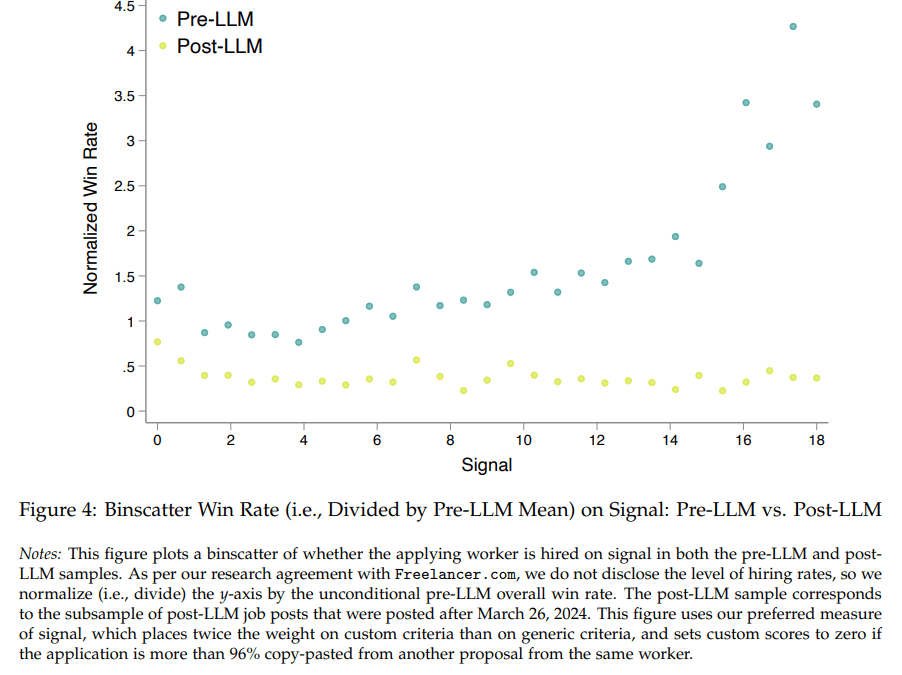
In the pre-ChatGPT era, their analysis showed employers had a strong willingness to pay premium rates for workers who submitted highly customized applications. A three-unit increase in their customization signal predicted between a 30-40% increase in hiring probability, even after controlling for other factors like bid price.
After ChatGPT's release in November 2022, this relationship began deteriorating. Following the introduction of Freelancer.com's own AI writing tool in April 2023, the predicted hiring probability increase from the same signal strength plummeted to just 10%.
The signal had lost two-thirds of its informational value.
To isolate AI's impact, Galdin and Silbert tracked hiring outcomes month-by-month to pinpoint exactly when the signal collapsed:
The Moment Hiring Signals Broke: After ChatGPT's release in November 2022, the predictive value of customized applications began declining. By April 2023, when Freelancer.com introduced AI writing tools, signal effectiveness had plummeted by 67%.
A Market for Lemons
To quantify the full equilibrium effects, the researchers built a structural economic model grounded in Michael Spence's classic signaling theory. They estimated the model using pre-LLM data, then simulated what would happen when LLMs rendered written applications useless as ability signals.
The results paint a concerning picture:
Workers in the top quintile of the ability distribution are now hired 19% less often than before LLMs. Meanwhile, workers in the bottom quintile are hired 14% more often. The market has become demonstrably less meritocratic.
This dynamic mirrors what economist George Akerlof described in his seminal "Market for Lemons" paper. When buyers cannot distinguish quality products from poor ones, information asymmetry causes market failure. High-quality sellers cannot credibly signal their superiority, leading to a race to the bottom where average quality declines and prices compress.
In today's hiring context, when every application appears polished and customized regardless of the candidate's actual abilities, employers grow skeptical of all applications. They cannot reliably separate genuine talent from AI-assisted mediocrity. Pay decreases because differentiation becomes impossible.
Using a structural economic model, the researchers simulated what happens when AI eliminates costly signals. The distribution of winners and losers is striking:

AI Made Hiring Less Meritocratic: When AI made applications costless to customize, labor markets became demonstrably less fair. The highest-ability workers (top quintile) saw their hiring rates drop 19%, while the lowest-ability workers (bottom quintile) gained a 14% advantage.
Why This Extends Far Beyond Freelancing
While the study focused on digital freelancing platforms, the implications ripple across all knowledge work hiring. The 87% of companies now using AI for recruitment face the same fundamental challenge: traditional screening methods are failing.
Consider:
College Admissions: Personal essays have long been viewed as windows into student character and potential. When AI can generate compelling narratives on demand, how do admissions officers distinguish authentic voice from algorithmic output?
Corporate Recruiting: Cover letters, writing samples, and even interview preparation materials can now be AI-generated with minimal effort. Traditional screening mechanisms lose their predictive power.
Performance Evaluation: When written communication no longer reliably signals capability, organizations must rethink how they assess and promote talent.
The Coasean Singularity and Transaction Costs
This research validates what economists have been warning about: we're approaching what MIT researchers call the "Coasean Singularity"e.g the point where AI reduces transaction costs in labor markets to near-zero.
When AI makes it costless to produce polished applications, the entire recruiting industry—built on the premise that screening requires human effort—faces existential disruption. Agencies charging 20-30% fees and recruiters spending 80% of their time on administrative tasks represent pure inefficiency when AI can handle these tasks instantly.
The question becomes: How do we restore signal quality in hiring when traditional methods have been compromised?
The Conversational AI Solution
This research validates what we've been building at shortlistd.io: traditional hiring methods are fundamentally broken in the age of generative AI. Text-based applications—whether resumes, cover letters, or written responses—can no longer serve their historical function as quality signals.
Our response has been to introduce what we call productive friction: conversational AI interviews that candidates cannot easily game with ChatGPT.
Here's why voice-based AI screening works where traditional methods fail:
Real-Time Adaptation
Unlike written applications that candidates can iterate on with AI assistance, conversational interviews require real-time responses. This recreates the costly signaling dynamic that made traditional customized applications valuable.
Recent research from University of Chicago and Erasmus University studying over 70,000 job applications found that AI voice interviews not only matched human performance but significantly outperformed traditional recruiters:
12% increase in job offers extended
18% increase in job starts (candidates actually showing up)
17% improvement in 30-day retention rates
24% more hiring-relevant topics covered in AI-led interviews
Critically, when given a choice between AI and human interviewers, 78% of candidates chose the AI interview. This isn't just employer preference—candidates recognize the value of consistent, unbiased screening.
Authentic Differentiation
Top performers can demonstrate their knowledge, problem-solving approach, and communication skills through natural conversation. These capabilities are far harder to fake than written responses that can be refined with multiple AI iterations.
Voice-based screening requires candidates to:
Think on their feet in real-time
Demonstrate actual knowledge, not memorized responses
Exhibit communication patterns that reveal personality and fit
Engage in follow-up questions that test depth of understanding
For candidates preparing for AI interviews, the challenge isn't gaming the system—it's genuinely demonstrating competence in a structured conversation.
Signal-Preserving Friction
The effort required to succeed in a thoughtful AI interview still correlates with worker quality. We're not eliminating screening—we're restoring its informational value through a different medium.
This addresses the core problem identified by the Princeton-Dartmouth research: we need signals that remain costly enough to separate high-ability workers from low-ability workers, but scalable enough to be economically viable.
Scalable Customization
While conversational AI maintains signal quality, it does so at scale impossible for human interviewers, making thorough screening economically viable even for high-volume roles.
Traditional recruiting faces a fundamental constraint: human recruiters work 8-hour days while great candidates are active 24/7. Our autonomous hiring intelligence platform operates continuously, engaging candidates across time zones and providing instant feedback.
The economics are compelling:
Traditional recruiter: $139,494 annually (fully loaded cost)
AI recruiting platform: $33,173 annually
Savings: 76% cost reduction
More importantly, AI doesn't just cost less, it delivers better outcomes through consistent evaluation, broader reach, and data-driven insights that continuously improve hiring decisions.
Rethinking Hiring for the AI Era
The Princeton-Dartmouth research makes clear that incremental adjustments won't suffice. Employers cannot simply add more resume screening or rely more heavily on keywords. When the fundamental signal has been compromised, entirely new mechanisms are required.
Organizations serious about hiring effectiveness need to ask themselves:
How are we adapting our application processes to account for AI-generated content?
What signals of candidate quality remain reliable in an LLM-saturated environment?
Are we inadvertently screening out top talent because our processes cannot distinguish them from average performers?
Have we addressed the regulatory landscape? The Mobley v. Workday case and EU AI Act are reshaping what's legally permissible in AI hiring.
The answer isn't to reject AI. That ship has sailed. The answer is to thoughtfully redesign hiring processes around signals that remain meaningful when everyone has access to sophisticated language models.
From Easy Apply to Intelligent Screening
Ironically, one of the biggest problems facing modern recruitment stems from removing friction too aggressively. As we've documented, the introduction of "easy apply" buttons across job platforms created an avalanche of applications—most of them unqualified.
The solution isn't more friction for its own sake. It's intelligent friction that:
Filters low-quality applicants who won't invest time in meaningful engagement
Showcases top talent through structured conversation that reveals capability
Scales economically without requiring proportional increases in human recruiters
Provides candidates with immediate feedback and transparent evaluation
This is the core insight behind conversational AI for hiring: we're not adding barriers—we're adding meaningful assessment that both employers and candidates value.
The Broader Lesson
This research illuminates a crucial principle for the AI age: when technology makes a signal costless to produce, that signal loses its informational value. This applies well beyond hiring to any domain that relied on costly effort as a quality indicator—academic admissions, professional certifications, creative work portfolios.
The challenge for leaders across these domains is to identify new forms of productive friction that genuinely distinguish capability while remaining economically viable to implement.
For hiring specifically, the evidence is clear: text-based applications are dead as quality signals. The question is whether organizations will adapt their processes before they've lost too many great candidates to information asymmetry.
What This Means for Recruiters
The implications for recruiting professionals are profound. The definitive analysis of whether AI will replace recruiters reveals that:
80% of current recruiting tasks can be automated by AI (resume screening, initial outreach, scheduling, basic qualification)
20% of recruiting work still requires human judgment (complex relationship building, cultural fit assessment, strategic workforce planning, executive placement)
The survivors will be those who transition from transactional screening to strategic talent advisory
The recruiters who thrive won't be those who resist AI—they'll be those who leverage it to elevate their work from administrative burden to strategic impact.
As one industry analyst put it: "AI will not replace 'agency recruitment'. The industry will change but continue to thrive. But it will take the jobs of many thousands of agency recruiters. Specifically, those that lack the advisory, consulting, insights and human influencing skills."
The Economics of Change
Beyond the human impact, the economics are undeniable. Organizations currently pay:
$4,700 per hire on average using traditional methods
20-30% of first-year salary to recruitment agencies
67 days average time-to-hire
AI-enhanced recruiting delivers:
76% cost reduction compared to traditional recruiting
23 days average time-to-hire (66% faster)
Continuous operation across all time zones and markets
When transaction costs approach zero, the entire economic structure of recruiting transforms. The question isn't whether this will happen—it's how quickly your organization adapts.
Building the Future of Hiring
At shortlistd.io, we're building what comes next: autonomous hiring intelligence that combines the efficiency of AI with the discernment previously possible only through human judgment.
Our platform operates as an AI workforce for hiring:
Autonomous sourcing across 200M+ profiles
Conversational screening that preserves signal quality
Intelligent interviewing that outperforms traditional methods
Continuous operation providing 24/7 candidate engagement
This isn't about replacing human recruiters—it's about augmenting them to focus on what they do best: building relationships, assessing cultural fit, and making strategic hiring decisions that shape organizational success.
Conclusion: Adapting to the New Reality
The Princeton-Dartmouth research provides empirical validation of what forward-thinking organizations already recognize: traditional hiring is broken, and AI is both the cause and the solution.
The problem: LLMs have destroyed the informational value of written applications, making it impossible to distinguish top talent from average performers using traditional methods.
The solution: Conversational AI that reintroduces productive friction, preserves signal quality, and scales economically all while providing better outcomes for both employers and candidates.
The choice facing organizations is stark: continue using screening methods that demonstrably fail to identify top talent, or embrace new approaches built for the AI era.
The companies that make this transition thoughtfully i.e combining AI efficiency with human judgment, will gain decisive advantages in the war for talent. Those that don't will find themselves losing great candidates to information asymmetry while paying premium prices for mediocre hires.
The future of hiring isn't human vs. AI. It's humans and AI working together, each doing what they do best.
And that future is already here.
Ready to See How Conversational AI Can Transform Your Hiring?
shortlistd.io's autonomous hiring intelligence platform is helping organizations worldwide move beyond broken resume screening to intelligent, scalable candidate assessment.
Book a demo to see how our AI agents can:
Source qualified candidates from 200M+ profiles
Screen applicants through structured voice conversations
Identify top talent that traditional methods miss
Reduce hiring costs by 76% while improving quality
Or explore more insights on AI recruitment:
About the Author
Adil Gwiazdowski is Co-founder & CEO of shortlistd.io, where he's building autonomous AI agents that source, screen, and interview candidates through conversational AI. With 20+ years in recruitment, including directing a $50M ARR tech talent business, he's focused on solving information asymmetry in modern labor markets.
Research Citation
Galdin, A., & Silbert, J. (2025). Making Talk Cheap: Generative AI and Labor Market Signaling. Job Market Paper, Princeton University & Dartmouth College. Available at: https://arxiv.org/abs/2511.08785
Related Topics: AI recruiting, labor market signaling, conversational AI, recruitment automation, hiring technology, information asymmetry, candidate screening, voice AI interviews, talent acquisition, future of recruitment


