shortlistd.io

Autonomous Hiring

What Is Autonomous Hiring?

Autonomous hiring uses AI recruitment agents to handle sourcing, outreach, screening, and first‑round interviews - while your team stays in control of every hiring decision.

Hire on Autopilot with Autonomous AI Agents

Take an intake call once. Autonomous AI agents then source, screen, and run structured interviews across every candidate, and hand your team decision‑ready shortlists. You keep humans in the loop for final interviews and offers; the agents handle the busywork.

AI agents execute sourcing, screening, and first‑round interviews.

Recruiters review shortlists and control who moves forward.

Works alongside your ATS and existing hiring process.
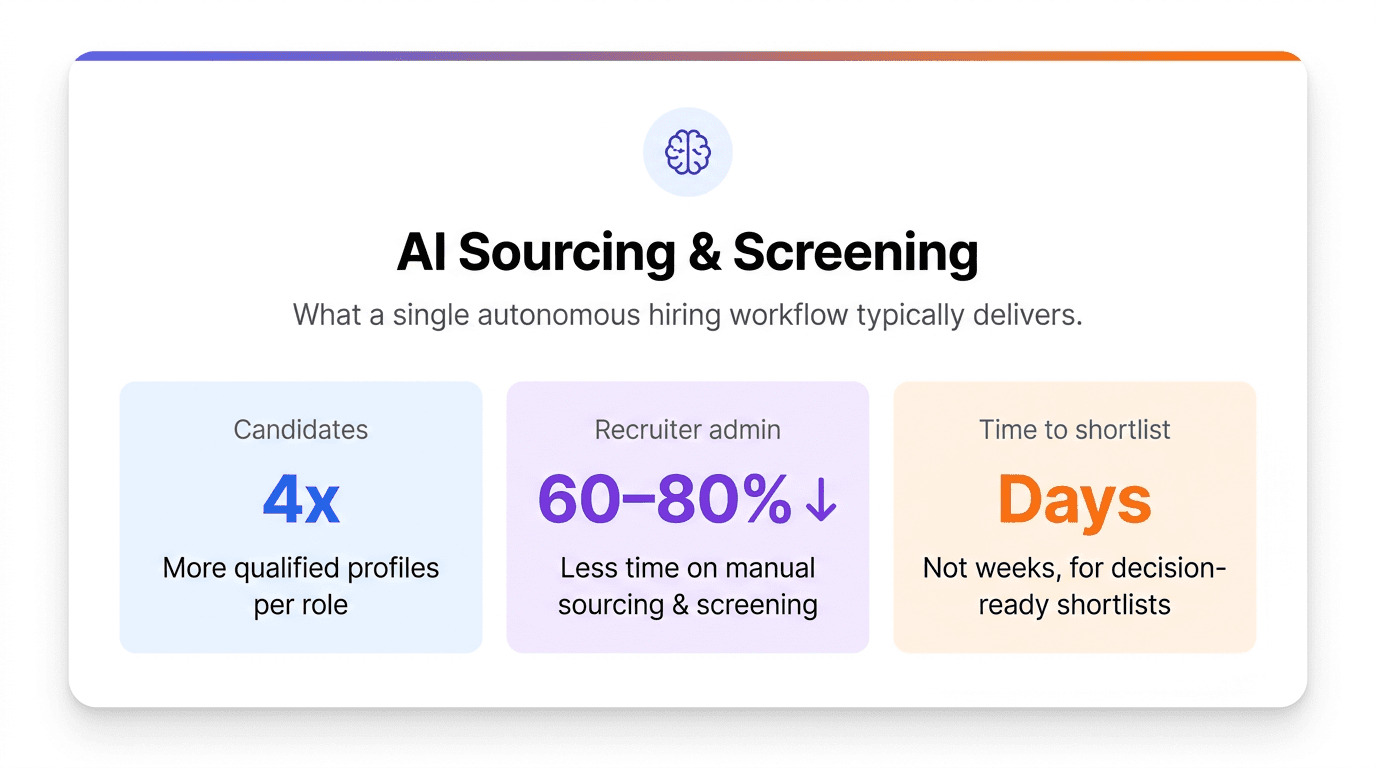
AI sourcing and screening results card showing three metrics: more qualified candidates, 60–80% less recruiter admin time, and time to shortlist measured in days rather than weeks.

What Makes Hiring Autonomous?

Six agents that work together — and with humans — to replace the manual steps in your hiring process, from intake and sourcing to interviews, feedback, and scheduling, without turning hiring into a black box.

Autonomous AI Job Intake Agent

Turns hiring requirements into structured search and interview criteria, so every workflow starts from a clear, consistent role brief.

Candidate Sourcing Agent

Searches across 800M profiles, profiles using semantic matching and natural language not brittle keyword strings.

AI Outreach & Scheduling Agent

Conducts multi‑channel outreach to qualified candidates, handles replies, and books interview slots with minimal recruiter involvement.

AI Voice Interview Agent

Runs structured, role‑specific voice interviews that collect comparable answers from every candidate, 24/7.

AI Copilot Interview Agent

Joins live calls, transcribes interviews, and tags key moments so recruiters and hiring managers get instant, searchable notes.

Automated Candidate Feedback Agent

Summarises each interview, highlights strengths and risks, and gives recruiters clear notes without manual typing.

Hero Background
shortlistd.io

Autonomous hiring step by step

How Autonomous Hiring Works Step by Step

Instead of one recruiter manually running every step, autonomous hiring chains a set of AI agents together. Each agent owns part of the workflow; humans supervise the whole thing and make the final decisions.

How Autonomous Hiring Works

Design hiring workflows once and let AI agents run them consistently across every role. Each agent owns part of the process—intake, sourcing, outreach, interviews, and feedback—while recruiters stay in control of shortlists and final decisions.

Intake and inbound agents turn your hiring brief into structured criteria, automatically screen CVs from applicants, and instantly invite strong fits to the next step.

Semantic sourcing and outreach agents continuously find qualified candidates beyond inbound, contact them, and book interviews with minimal admin.

AI interview, copilot, and feedback agents run structured interviews, transcribe calls, score answers, and deliver decision‑ready shortlists for your team to review.
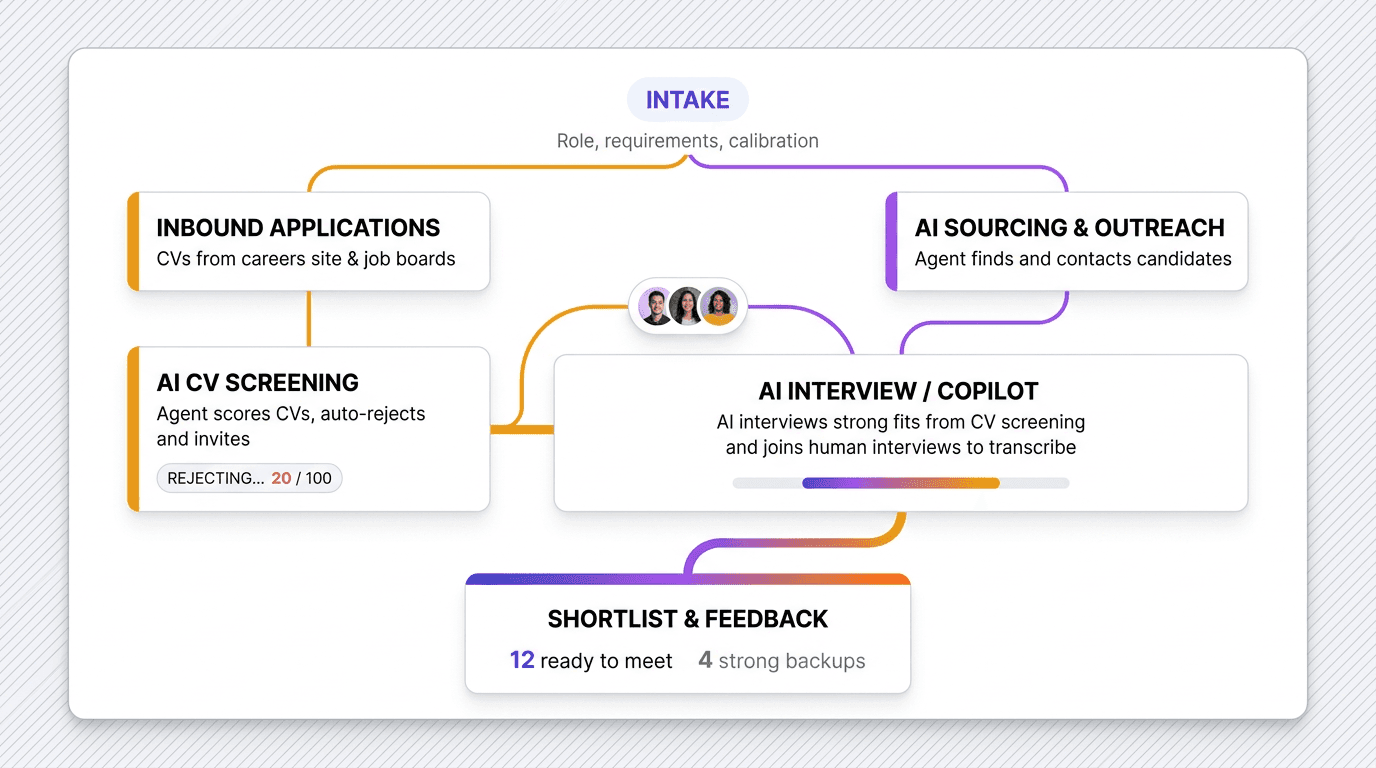
Workflow diagram showing the shortlistd.io autonomous hiring process, from intake through inbound applications, AI CV screening and AI sourcing to AI interview/copilot and a final shortlist and feedback stage.
shortlistd.io

Autonomous Worflow

How the autonomous hiring workflow actually runs

Four stages that replace weeks of manual recruiter effort.

Stage 1: Intelligent Candidate Sourcing

AI agents search across hundreds of millions of professional profiles (LinkedIn, job boards, and other databases), not just your ATS.

  • They use semantic understanding to match real skills, experience, and potential fit to the intake profile, instead of relying on keywords

  • Qualified candidates are proactively engaged with personalised outreach at scale, within hours of opening a role.

  • Traditional: a recruiter spends days manually searching LinkedIn, reviewing profiles, and sending one‑off messages.

  • Autonomous: agents scan the wider market, surface top matches fast, and start conversations automatically—leading to several times more qualified candidates in a fraction of the time.

Stage 2: Automated Screening

The system evaluates each candidate against the live job requirements, analysing CVs, work history, skills, and seniority.

  • It assigns a clear fit score for the specific role, instantly highlighting who should move forward.

  • Every profile is treated the same way, so strong candidates aren’t missed because of format, timing, or reviewer fatigue.

  • Traditional: recruiters skim each resume for a few seconds and make subjective keep/reject decisions.

  • Autonomous: the AI screens hundreds of profiles in parallel using consistent criteria and produces an ordered list of who’s worth interviewing.

Smart Resume Screening

AI agents search across hundreds of millions of professional profiles (LinkedIn, job boards, and other databases), not just your ATS.

  • They use semantic understanding to match real skills, experience, and potential fit to the intake profile, instead of relying on keywords

  • Qualified candidates are proactively engaged with personalised outreach at scale, within hours of opening a role.

  • Traditional: a recruiter spends days manually searching LinkedIn, reviewing profiles, and sending one‑off messages.

  • Autonomous: agents scan the wider market, surface top matches fast, and start conversations automatically—leading to several times more qualified candidates in a fraction of the time.

Stage 2: Automated Screening

The system evaluates each candidate against the live job requirements, analysing CVs, work history, skills, and seniority.

  • It assigns a clear fit score for the specific role, instantly highlighting who should move forward.

  • Every profile is treated the same way, so strong candidates aren’t missed because of format, timing, or reviewer fatigue.

  • Traditional: recruiters skim each resume for a few seconds and make subjective keep/reject decisions.

  • Autonomous: the AI screens hundreds of profiles in parallel using consistent criteria and produces an ordered list of who’s worth interviewing.

Smart ResumeScreening

AI agents search across hundreds of millions of professional profiles (LinkedIn, job boards, and other databases), not just your ATS.

  • They use semantic understanding to match real skills, experience, and potential fit to the intake profile, instead of relying on keywords

  • Qualified candidates are proactively engaged with personalised outreach at scale, within hours of opening a role.

  • Traditional: a recruiter spends days manually searching LinkedIn, reviewing profiles, and sending one‑off messages.

  • Autonomous: agents scan the wider market, surface top matches fast, and start conversations automatically—leading to several times more qualified candidates in a fraction of the time.

Stage 2: Automated Screening

The system evaluates each candidate against the live job requirements, analysing CVs, work history, skills, and seniority.

  • It assigns a clear fit score for the specific role, instantly highlighting who should move forward.

  • Every profile is treated the same way, so strong candidates aren’t missed because of format, timing, or reviewer fatigue.

  • Traditional: recruiters skim each resume for a few seconds and make subjective keep/reject decisions.

  • Autonomous: the AI screens hundreds of profiles in parallel using consistent criteria and produces an ordered list of who’s worth interviewing.

Stage 3: AI‑Led Interviews

Candidates move straight into structured voice or video interviews run by the AI, available 24/7 in their own time zone.

  • The agent asks role‑specific questions tuned to the intake profile and probes for depth, examples, and real competency.

  • Responses are evaluated for relevance and quality, and every conversation is automatically transcribed and summarised.

  • Traditional: recruiters schedule and run phone screens one by one, taking notes and trying to keep interviews consistent.

  • Autonomous: AI interviews candidates within hours of application, removes scheduling bottlenecks, and produces richer, more comparable insight from each conversation.

Stage 4: Candidate Ranking & Presentation

For each person, the system builds a complete profile: interview performance, skills assessment, experience relevance, and predicted fit.

  • Candidates are ranked by overall score, with clear reasons and evidence behind each recommendation.

  • Hiring managers see a shortlist of pre‑screened, pre‑interviewed candidates, with everything they need to decide who to meet.

  • Traditional: recruiters compile notes and summaries by hand, then try to explain why certain candidates made the cut.

  • Autonomous: detailed assessments and shortlists are generated automatically, so managers get decision‑ready shortlists in days instead of weeks.

Stage 3: AI‑Led Interviews

Candidates move straight into structured voice or video interviews run by the AI, available 24/7 in their own time zone.

  • The agent asks role‑specific questions tuned to the intake profile and probes for depth, examples, and real competency.

  • Responses are evaluated for relevance and quality, and every conversation is automatically transcribed and summarised.

  • Traditional: recruiters schedule and run phone screens one by one, taking notes and trying to keep interviews consistent.

  • Autonomous: AI interviews candidates within hours of application, removes scheduling bottlenecks, and produces richer, more comparable insight from each conversation.

Stage 4: Candidate Ranking & Presentation

For each person, the system builds a complete profile: interview performance, skills assessment, experience relevance, and predicted fit.

  • Candidates are ranked by overall score, with clear reasons and evidence behind each recommendation.

  • Hiring managers see a shortlist of pre‑screened, pre‑interviewed candidates, with everything they need to decide who to meet.

  • Traditional: recruiters compile notes and summaries by hand, then try to explain why certain candidates made the cut.

  • Autonomous: detailed assessments and shortlists are generated automatically, so managers get decision‑ready shortlists in days instead of weeks.

shortlistd.io

Benefits

What changes once this workflow is running

You still make the hiring decisions; the agents do everything that leads up to them.

Shortlists in days, not weeks

With agents handling intake, CV screening, sourcing, and interviews in parallel, the entire front half of your funnel compresses dramatically. Instead of waiting two or three weeks for a recruiter to post roles, chase hiring managers, sift through inbound, and manually line up first‑round calls, you open a role and watch a shortlist build itself. Within a few days you already have a ranked set of candidates who have been screened, interviewed, and summarised—so your time goes into decision‑making and stakeholder alignment, not simply getting to ‘shortlist ready’

More high‑intent candidates

Most teams only consider whoever applied first or happened to already sit in the ATS. With agents continuously working both inbound and outbound, every role pulls from a much larger, far more relevant pool. Inbound CVs are scored against a an intake profile. In parallel, agents search beyond your existing database, reach out to new prospects, and invite only the ones who match and engage. The result is a shortlist filled with candidates who are both qualified and interested, not just the ones who were easiest to find.

Smart Resume Screening

With agents handling intake, CV screening, sourcing, and interviews in parallel, the entire front half of your funnel compresses dramatically. Instead of waiting two or three weeks for a recruiter to post roles, chase hiring managers, sift through inbound, and manually line up first‑round calls, you open a role and watch a shortlist build itself. Within a few days you already have a ranked set of candidates who have been screened, interviewed, and summarised—so your time goes into decision‑making and stakeholder alignment, not simply getting to ‘shortlist ready’

More high‑intent candidates

Most teams only consider whoever applied first or happened to already sit in the ATS. With agents continuously working both inbound and outbound, every role pulls from a much larger, far more relevant pool. Inbound CVs are scored against a an intake profile. In parallel, agents search beyond your existing database, reach out to new prospects, and invite only the ones who match and engage. The result is a shortlist filled with candidates who are both qualified and interested, not just the ones who were easiest to find.

Smart ResumeScreening

With agents handling intake, CV screening, sourcing, and interviews in parallel, the entire front half of your funnel compresses dramatically. Instead of waiting two or three weeks for a recruiter to post roles, chase hiring managers, sift through inbound, and manually line up first‑round calls, you open a role and watch a shortlist build itself. Within a few days you already have a ranked set of candidates who have been screened, interviewed, and summarised—so your time goes into decision‑making and stakeholder alignment, not simply getting to ‘shortlist ready’

More high‑intent candidates

Most teams only consider whoever applied first or happened to already sit in the ATS. With agents continuously working both inbound and outbound, every role pulls from a much larger, far more relevant pool. Inbound CVs are scored against a an intake profile. In parallel, agents search beyond your existing database, reach out to new prospects, and invite only the ones who match and engage. The result is a shortlist filled with candidates who are both qualified and interested, not just the ones who were easiest to find.

Recruiters focus on impact

Today, recruiters spend most of their week moving information around: triaging inboxes, updating spreadsheets, rescheduling calls, and trying to remember which candidate is where. Once agents are running this workflow, that overhead disappears. Intake notes are turned into structured profiles, CVs are screened automatically, scheduling happens without back‑and‑forth, and first‑round interviews follow a consistent script. Recruiters step back into a higher‑leverage role—calibrating with hiring managers, shaping the narrative of the role, coaching candidates through offers, and making the judgment calls machines can’t.

Every interview is structured

In most processes, interviews generate a flurry of ad‑hoc notes, half‑remembered impressions, and the occasional scorecard—hardly a reliable basis for a big hiring decision. With AI interviews and AI copilots, every conversation is captured, structured, and compared. The system produces transcripts, concise summaries, and risk flags aligned to the intake profile, so hiring managers can scan what matters in minutes instead of guessing from gut feel. When you sit down to choose your next hire, you’re looking at a shortlist backed by evidence: what each person said, how it maps to the role, and where the trade‑offs really lie.

Recruiters focus on impact

Today, recruiters spend most of their week moving information around: triaging inboxes, updating spreadsheets, rescheduling calls, and trying to remember which candidate is where. Once agents are running this workflow, that overhead disappears. Intake notes are turned into structured profiles, CVs are screened automatically, scheduling happens without back‑and‑forth, and first‑round interviews follow a consistent script. Recruiters step back into a higher‑leverage role—calibrating with hiring managers, shaping the narrative of the role, coaching candidates through offers, and making the judgment calls machines can’t.

Every interview is structured

In most processes, interviews generate a flurry of ad‑hoc notes, half‑remembered impressions, and the occasional scorecard—hardly a reliable basis for a big hiring decision. With AI interviews and AI copilots, every conversation is captured, structured, and compared. The system produces transcripts, concise summaries, and risk flags aligned to the intake profile, so hiring managers can scan what matters in minutes instead of guessing from gut feel. When you sit down to choose your next hire, you’re looking at a shortlist backed by evidence: what each person said, how it maps to the role, and where the trade‑offs really lie.

shortlistd.io

Autonomous hiring comparison

How is Autonomous Hiring Different?

Traditional hiring tools and services were designed to support recruiters, not to do the work. shortlistd.io replaces manual sourcing, CV screening, and first-round interviews with AI agents that deliver shortlists.


Autonomous Hiring vs ATS vs Recruiters

Features

Primary Function

Candidate Sourcing

Screening Method

First-Round Interviews

Speed to Shortlist

Scalability

Cost Structure

Bias Reduction

Human Involvement

Best Use Case

What It Replaces

shortlistd.io

Executes hiring work end-to-end using AI agents

Autonomous semantic AI sourcing (skills-based)

Skills-based AI evaluation

AI-led structured voice interviews

Hours to days

Parallel hiring across many roles

Platform or success-based, predictable

Structured questions, consistent scoring

Minimal, human-in-the-loop

Volume hiring, fast-growing teams, agency replacement

Manual sourcing, screening, and first interviews

ATS Platforms

Manages applicants and workflows

None or limited integrations

CV and keyword filtering

Not included

Weeks

Limited by recruiter capacity

Software subscription

Depends on human screening

High

Applicant tracking & compliance

Spreadsheets

Recruitment Agencies

Manually sources and screens candidates

Manual recruiter sourcing

Human CV review

Manual recruiter calls

Weeks

Limited by consultant availability

High placement fees (15–30%)

High variability between recruiters

Very high

Niche or executive search

Internal Recruiter effort

shortlistd.io

FAQ

Autonomous hiring, legality, and how it really works

Straight answers on where AI fits into hiring law, why shortlistd.io keeps humans in charge of decisions, and a deeper look in our guide “Is Autonomous Hiring Legal?”

Is autonomous hiring actually legal?

Yes. Using AI in hiring is legal as long as you prevent discrimination, protect candidate data, and keep humans in control of final decisions. It’s about how you use it, not whether if use it.

Who is responsible if something goes wrong?

You, the employer, stay responsible for hiring decisions. A good vendor gives you audits, logs, and controls, but regulators still see you as the decision‑maker.

Does this replace recruiters?

No. It replaces repetitive work, not people. Agents do sourcing, screening, and first interviews; recruiters focus on calibration, stakeholder management, and final hiring calls.

Can AI be fairer than humans?

It can. Human judgment is hard to measure; AI can be tested and tuned for bias. With the right checks, you get more consistent decisions and clearer evidence than manual screening.

Are fully automated “no‑human” decisions allowed?

For hiring, that’s not what regulators want. High‑impact decisions should always have a human in the loop who can review, override, and explain the outcome.

What do we have to tell candidates?

You should be upfront that AI is used, what it evaluates, and how candidates can ask for more information or a human review. Clear, simple language goes a long way.

How is candidate data protected?

Autonomous hiring should follow modern privacy standards: only collect what you need, store it securely, limit retention, and give candidates control over their data.

What if the AI makes a bad or biased call?

On shortlistd.io, AI never makes the final hiring decision. The agents recommend who to move forward, but humans always review, override, or reject those recommendations.

Why move to autonomous hiring now?

Teams that adopt early hire faster, with better documentation and less manual risk. You get speed and scale today, and you’re already aligned with where regulation is heading.

Dark gradient background
shortlistd.io

Try Autonomous AI Hiring

Ready to Try Autonomous Hiring on your hiring?

Start with a trial on a few roles, compare the results to your current process, and only expand once you’ve seen the impact.