
The Radio Interview That Made Us Defend AI Hiring With Data
Written By
Adil
Co-founder
What happens when you put two AI recruitment founders on the spot about whether algorithms can beat human judgment
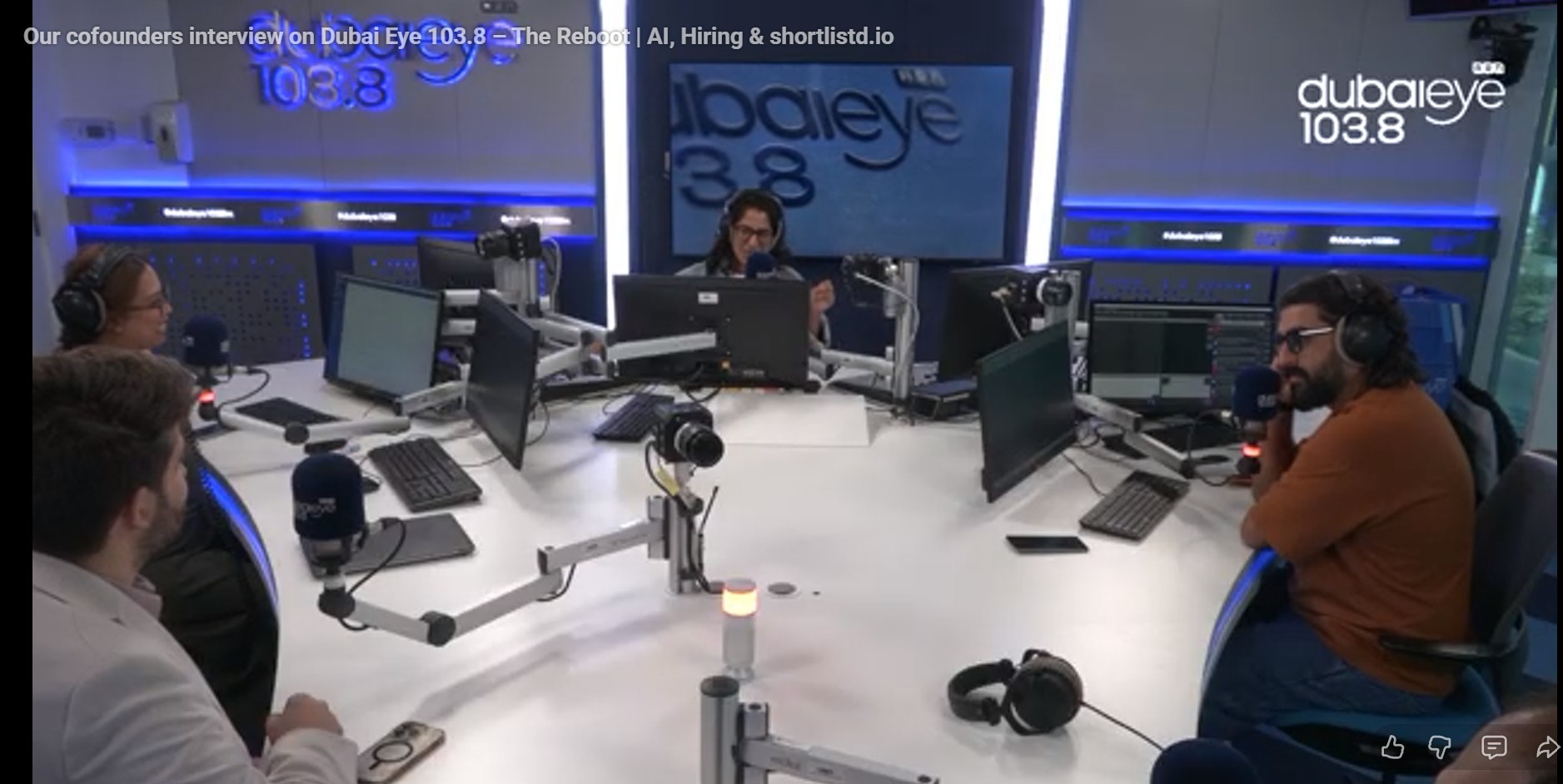
We sat down with Zeena Zalamea for what we thought would be a standard product interview. Instead, she asked the questions that actually matter.
Not "what features does your platform have?" but "do candidates actually want this?" and "how do you know AI isn't just automating bias?"
Turns out, when you're forced to defend your entire business model on the record, you better have receipts.
Good thing we do.
The Question That Stopped Me Cold
"Human hiring managers make mistakes due to bias," Zeena said. "What's the success rate of AI in hiring?"
Simple question. Loaded implications.
She wasn't asking for our marketing pitch. She wanted data.
So I told her about the study. Not our study—we didn't pay for it, we didn't conduct it, and frankly, when it first came out, it scared us a bit.
The 70,000-Person Study That Made Us Nervous (Then Excited)
Two economists—Brian Jabarian from University of Chicago and Luca Henkel from Erasmus University—spent months analyzing over 70,000 actual job applications.
They wanted to answer one question: Can AI voice agents conduct job interviews as well as experienced human recruiters?
Not "do candidates hate it?" Not "is it cheaper?" But: Does it actually work better?
Here's what they found:
→ 12% more job offers extended
→ 18% more candidates actually showed up to work
→ 17% better retention after 30 days
→ 24% more job-relevant information gathered per interview
But here's the stat that blew my mind:
When given a choice between a human interviewer or an AI interviewer, 78% of candidates chose the AI.
Let that sink in.
Three out of four people, when given the option, said "yeah, I'll talk to the robot, thanks."
Why Do Candidates Prefer Talking to AI?
This was the part of the interview where Yatin jumped in, and I'm glad he did because he explained it better than I could.
Think about it from the candidate's perspective:
With a human interviewer:
You need to find a time that works for both schedules
You're being judged on your appearance, accent, small talk
They might be having a bad day
They might have unconscious bias about your background
They ask different questions to different candidates
With an AI interviewer:
Interview at 2 AM if that's when you're free
No one's judging your outfit or accent
Same questions every single time
No unconscious bias about your school, background, or appearance
You can focus on demonstrating your skills, not performing likability
One candidate in a survey said: "I'm an introvert. The AI didn't make me do small talk about the weather. It just asked about the job. That was refreshing."
Another: "I'm a single parent. Being able to interview after my kids went to bed instead of finding childcare was huge."
Read more about what candidates really think: What Candidates Actually Think About AI Interviews
"But Isn't AI Interviews Disrespectful?"
This came up in a different interview, and Yatin's response was perfect:
"What's the alternative?"
Right now, candidates face:
61% get ghosted after interviews (up 9 points since April 2024)
48% ghosted in the past year
78% more frustrated by application ghosting than dating ghosting
40% of unemployed people had ZERO interviews in 2024
So when someone says AI interviews are "disrespectful," I ask: Is silence more respectful?
Is getting your resume screened out in 6 seconds by a keyword filter more respectful?
Is spending 4 hours on a take-home assignment and never hearing back more respectful?
AI interviews don't replace human connection. They replace the black hole.
Every candidate who talks to our AI gets:
Actual questions about their skills
A complete transcript of the conversation
Transparent scoring with specific examples
A human hiring manager who reviews everything
No one gets lost in the void.
How Shortlistd Actually Works (The Real Story)
Zeena asked us to walk through the platform, and this is where Yatin geeked out in the best way.
[EMBED VIDEO: Yatin Walks Through Shortlistd Platform]
Step 1: We Draft the Job Description With You
Not a template. Not a form. A conversation.
Our AI sits down with the hiring manager and asks:
What does this person actually need to do?
What skills are must-haves vs. nice-to-haves?
What's the actual day-to-day look like?
The output? A JD that describes the job, not corporate buzzword bingo.
Step 2: Semantic Search Across 800M+ Profiles
Here's where it gets interesting.
Traditional job boards search for exact keyword matches:
You search for "Python engineer"
You miss the person who wrote "software developer with Python experience"
Our semantic search understands meaning:
Finds the cybersecurity expert with military background, not just corporate titles
Identifies the marketing lead who's never used your exact buzzwords but has all the skills
Matches on capabilities, not just credentials
More on how this works: Beyond Keywords: How Semantic Search Actually Works
Step 3: Personalized Outreach (Not Spam)
Every candidate gets a message explaining why they specifically are a fit for this specific role.
Not: "Great opportunity! Apply now!"
But: "I saw your background in X, and given your experience with Y, you'd be perfect for Z because..."
Step 4: AI Conducts the Interview
When candidates respond, our AI interviews them.
What that looks like:
Natural voice conversation (not a chatbot)
Adaptive follow-up questions based on their answers
Available 24/7, any timezone
Same core questions for everyone (fairness)
What the hiring manager gets:
Full transcript of every conversation
Structured scoring with specific examples
Comparative analysis across candidates
Clear insights to make the decision
Notice what's missing? The hiring manager still makes the decision.
We don't automate judgment. We automate the tedious stuff that prevents good judgment.
The Part Where We Get Honest About Bias
Look, here's the uncomfortable truth:
Humans are biased. Not because we're bad people. Because we're human.
Your brain evolved to make snap judgments. That kept your ancestors alive. It makes you a bad interviewer.
You prefer:
People from schools you recognize
Candidates who share your communication style
People who look like you or your team
Career paths that make sense to you
That's not malice. That's neuroscience.
AI doesn't have those shortcuts.
Every candidate gets:
Same questions
Same evaluation criteria
Same scoring methodology
Same chance to demonstrate skills
The University of Chicago study showed that human recruiters reviewing transcripts (blind to whether AI or human conducted the interview) rated AI-interviewed candidates higher.
Why? Because AI extracted more relevant information. It asked better follow-ups. It didn't get distracted.
Read the full research breakdown: AI Voice Interviews Outperform Human Recruiters: The Data
The Uncomfortable Questions (And Our Answers)
"Are you trying to replace recruiters?"
No.
We're trying to replace the parts of recruiting that make recruiters hate their jobs.
80% of recruiter time is spent on administrative tasks. Scheduling. Chasing people. Screening hundreds of CVs.
The stuff that doesn't require human judgment.
AI handles that. Recruiters handle:
Building relationships with hiring managers
Understanding company culture
Strategic workforce planning
The actual hiring decision
That's the stuff that matters. That's where humans are irreplaceable.
More on this: Will AI Replace Recruiters? The Real Answer
"What about candidates who aren't tech-savvy?"
Fair question. About 5-7% of candidates have technical issues.
We provide:
Clear instructions upfront
Practice interview option
Human fallback when needed
Technical support
But here's the thing: the vast majority find it easier than coordinating schedules across time zones for a 30-minute phone screen.
"Can this work for senior roles?"
Yes, but differently.
For senior positions:
AI handles: Initial qualification, technical screening, objective skill verification
Humans handle: Strategic thinking assessment, leadership evaluation, cultural fit, offer negotiations
It's not either/or. It's both.
The hybrid model beats AI-only or human-only. We've seen this across 100+ hours of interviews with talent leaders.
What This Actually Means for Hiring
After the interview wrapped up, Zeena asked one more question off-camera:
"So what's the real impact here? Like, bottom line?"
Here it is:
AI interviews aren't about cutting costs or replacing people.
They're about:
Giving every candidate a fair shot
Removing bias we didn't even know we had
Respecting everyone's time
Making better hiring decisions
The data shows it works:
12% more offers means you're finding qualified people you would have missed
18% more job starts means better candidate experience throughout
17% better retention means you're hiring the right people
This isn't about efficiency. It's about effectiveness.
And yeah, it happens to be more efficient too.
The Future We're Building
We're not building a world where AI replaces human judgment.
We're building a world where:
Every candidate gets heard, not filtered out by keywords
Every interview is fair, not biased by bad days or unconscious preferences
Every hiring decision is based on skills, not schools
Every recruiter spends time on strategy, not scheduling
That's what the pivot to autonomous hiring intelligence is really about.
The research backs it up. The candidates prefer it. The hiring outcomes prove it.
Now it's about getting more companies on board before their competitors do.
Want to See It in Action?
Watch the full interview where we get grilled on AI bias, candidate experience, and whether robots are taking recruiter jobs:
Or see how it actually works:
Because the best way to understand if AI interviews work? See them work.
One More Thing...
The researcher who conducted the 70,000-person study, Dr. Brian Jabarian, said something that stuck with me:
"What we found from data in our large-scale study was that Anna AI can match human recruiters in conducting job interviews—a complex but key task in hiring—while preserving candidate satisfaction, maintaining smooth operations, and improving hiring efficiency and early retention."
He didn't say AI was perfect.
He said AI matched humans while improving outcomes.
That's not a replacement story.
That's an augmentation story.
And that's the future of hiring.
Related Posts:


